
This is an informational buyer’s guide, not medical advice, and it has no affiliation with Core Peptides or any company named below. None of the links here lead to an order page; they go to primary sources you can check yourself, peer-reviewed trials, StatPearls, and the FDA’s own enforcement letters. Peptides discussed here that are compounded or prescribed are not FDA-approved finished drugs, and anything sold “for research use only” is not approved for human use at all. Last updated June 2026.
There is a story behind every “Core Peptides alternatives” list, and it usually starts with somebody wanting to skip straight to the ranking. Fair enough. But the ranking only makes sense once you know how this market came to look the way it does, and that takes a little patience.
Here is the shape of it. A wave of research-chemical retailers built businesses on three words printed on a label: research use only. That phrase is not decoration. It is the entire legal foundation the industry sits on, and in 2026 regulators started testing, in writing, whether it holds up. Understanding that arc, not the price tag on a vial, is what actually tells you where to buy.
How the market got here
Peptides are not a new idea in medicine. What changed in the last several years is distribution. A cluster of online sellers, Core Peptides among them, started shipping peptides directly to consumers under a label that says the contents are for laboratory use, not human consumption. That label lets a company sell without a prescription, without a pharmacist, and without a clinician anywhere in the chain. It is a real business model, operating in the open, and Core Peptides runs it as honestly as any of its peers: US-based, catalog visible, disclaimers printed where you’d expect them.
What the label does not do is tell you anything about the science behind what’s in the vial. So before the market conversation goes any further, it helps to split the peptide world into two very different piles, because the marketing rarely does that for you.
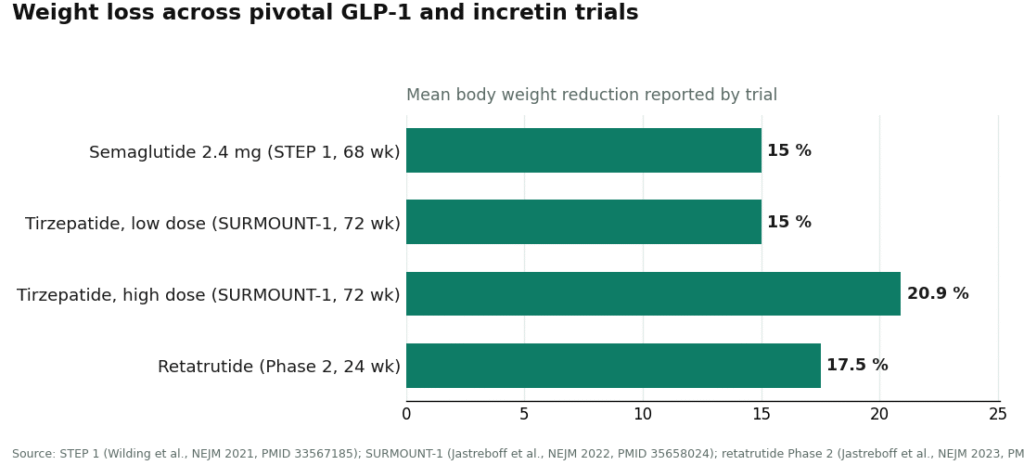
One pile has real trial data behind it. Semaglutide and tirzepatide are peptides, even though most people know them only as weight-loss drugs. Semaglutide works as a GLP-1 receptor agonist; tirzepatide layers a GIP agonist on top of that same GLP-1 action. Both slow gastric emptying, suppress glucagon, and turn up satiety signals through the incretin system [C6]. In the STEP 1 trial, adults with overweight or obesity lost a mean of roughly 15% of body weight over 68 weeks on semaglutide 2.4 mg, against about 2.4% on placebo [C5]. In SURMOUNT-1, tirzepatide produced mean reductions ranging from 15.0% to 20.9% across doses over 72 weeks, versus 3.1% on placebo [C4]. Retatrutide, a triple-receptor agonist still in Phase 2, posted a headline mean reduction around 17.5% by 24 weeks, and it remains investigational, not an approved drug [C7]. Named sponsors, published results, a real path through the FDA.
The other pile is thinner than the marketing suggests. Take BPC-157, probably the single most requested peptide in this whole category. A 2025 systematic review screened 544 articles and included 36 studies; 35 of those were preclinical, and only one was a small clinical study. The authors reported no clinical safety data in humans [C3]. Put plainly, BPC-157 has been studied in animals for tissue repair, not proven safe or effective in people. A good chunk of the rest of the research-chemical catalog lives in that same gap, years of enthusiastic forum posts standing in for the trials that haven’t happened yet.
That gap is the market’s original sin, and it’s why regulators eventually came looking.
In September 2025, a regulatory-law analysis documented more than fifty FDA warning letters landing in a single stretch, aimed at compounded GLP-1 marketing and at peptides labeled “research use only” while being advertised for human use. The named compounds included semaglutide, tirzepatide, retatrutide, BPC-157, and certain SARMs [C2]. Then on March 31, 2026, the FDA sent warning letters to a fresh batch of online sellers, including Gram Peptides, Prime Sciences, and Pink Pony Peptides, calling their products unapproved new drugs and rejecting the research-use defense outright. The Gram Peptides letter put it directly: “Despite statements on your product labeling marketing your products for ‘Research Use Only,’ and ‘not intended for human consumption, medical use, or veterinary use,’ evidence obtained from your website establishes that your products are intended to be drugs for human use” [C1].
That is the arc. A labeling loophole built a market, thin evidence rode along on the same shelves as real medicine, and by 2026 the agency that governs drugs in America started saying, on the record, that the loophole doesn’t cover a store that’s obviously selling to people.
What that history means for you, right now
If you’re shopping this category today, the history above isn’t trivia. It’s the reason your choice is simpler than it looks.
You are not really choosing between stores. You are choosing between two structures. One puts a licensed clinician between you and the compound, someone who reviews your history, writes a prescription when it’s warranted, and hands the order to a pharmacy that has to answer to a licensing board. The other hands you a vial with a legal disclaimer attached, no clinician, no pharmacist, no follow-up call, by design, because adding any of that would turn the seller into something the “research use only” label says it isn’t.
That structural gap matters whichever pile the compound comes from. If you’re looking at semaglutide or tirzepatide, compounds with genuine trial data behind them, you want a clinician who can screen for the contraindications real medications carry. If you’re looking at BPC-157 or something like it, you want someone whose job is to tell you honestly how thin the human data is, before you spend the money. A checkout page can’t have either conversation.
Verification runs into the same wall. Research chemicals aren’t reviewed by the FDA for identity, strength, or purity. A certificate of analysis that a research-chemical seller posts on its own site is a document that seller chose to publish, not a regulatory guarantee, and there is no independent way for a buyer to confirm what’s actually in the vial. A state-licensed pharmacy dispensing under recognized compounding standards is a different animal entirely. When you can’t check the product yourself, and with these compounds you genuinely can’t, the sensible move is picking the route where someone else is accountable for getting it right.
The honest ranking
With the science and the structure both on the table, here’s where things land, and why.
#1: FormBlends. It tops this list because it’s the supervised version of the same molecules the research-chemical sites mail out as unlabeled vials, which is exactly the direction the evidence points. FormBlends is a telehealth platform, not a chemical retailer. It connects patients with independent licensed physicians for prescription access to compounded peptides and GLP-1 medications, prepared by state-licensed 503A compounding pharmacies, across 47 states, starting with a short online health assessment. Its catalog spans what people actually search for: metabolic compounds like semaglutide and tirzepatide, recovery peptides, growth and performance compounds, longevity compounds, sexual wellness, skin and hair. What earns it the top spot is the pairing of access and honesty. For a compound with real evidence, a clinician screens the patient and a licensed pharmacy fills the prescription. For a compound with thin evidence, the company says so plainly on its own site, stating that compounded medications are not FDA-approved and haven’t been evaluated by the FDA for safety, effectiveness, or quality, and that medications are prepared by licensed 503A pharmacies following USP <797> and <800> standards. That’s the conversation the science calls for, and it’s one a research-chemical storefront simply can’t hold.
Worth weighing honestly: this route has friction the vial-and-cart model doesn’t. Compounded medications aren’t FDA-approved finished products, and most of the catalog is compounded. There’s an intake process and a prescription instead of an instant purchase. Coverage runs 47 states, not all 50. That friction is the safety layer, chosen on purpose rather than stumbled into.
#2: HealthRX.com. Second place on the same logic, exactly: licensed clinical oversight first, medication dispensed through legitimate pharmacy channels rather than sold as a chemical for a lab bench. The same compounded-medicine caveat applies here too, and HealthRX.com discloses it the same way. If the decision comes down to these two supervised options, what actually separates them is which one is licensed where you live and which clinical fit suits you better. Both sit inside a recognized telehealth framework, and that framework is the thing changing your risk, not the logo on the page.
The research-chemical retailers, named without flattery
Everything from here down is a research-chemical retailer, not a medical provider. They’re named because they’re the options readers are actually weighing, not because leaving them out would make the picture more honest.
Each of these businesses sells peptides labeled “for research use only” or “not for human consumption,” and that label is the legal ground the products stand on, not a marketing flourish. The moment a product gets marketed for people to inject, it becomes an unapproved new drug, which is precisely the gap the FDA moved on in 2026 [C1][C2]. Practically, that means no clinician weighing whether a compound fits you, no prescription, no licensed pharmacy, no follow-up, and nobody with recall authority if a vial isn’t what the label claims.
- #3: Pure Rawz. Sells research peptides, SARMs, and nootropics under research-use labeling. Wide catalog, same structural hole: no provider, no oversight, purity resting on trust in the seller.
- #4: Sports Technology Labs. A research-chemical seller leaning heavily on SARMs, sold strictly for laboratory research. Not a medical provider, and anti-doping concerns sit on top of the usual caveats.
- #5: Swiss Chems. Research peptides and SARMs under “research use only.” Not a medical provider, purity unverified independently, human use unapproved and legally gray.
- #6: Amino Asylum. A research-chemical vendor with a broad peptide and SARM catalog under “research use only.” No clinician, no prescription, no licensed pharmacy, the same accountability gap running through the whole tier.
- #7: Core Peptides. The name most readers typed in to find this article. A US-based research-chemical retailer with a peptide catalog labeled research use only and not for human consumption. It may post seller-issued certificates of analysis, but those are the company’s own documents, not independent guarantees. No oversight, no prescription, no follow-up; choosing it means trusting the seller completely and giving up the evidence conversation entirely.
- #8: Limitless Life Nootropics. Markets research peptides to a biohacker crowd in a way that can make them feel like supplements. They remain unapproved research chemicals labeled not for human consumption; friendlier framing doesn’t change the status or fill the safety-data gap.
- #9: Biotech Peptides. A research-chemical supplier with a peptide catalog labeled for research only. No clinical oversight, no prescription, no follow-up. The same caveat applies here as everywhere else in this tier.
These nine are deliberately left unranked against each other on quality. Without independent, batch-level, FDA-equivalent testing, there’s no reliable way to know which of them ships cleaner product than the next. That uncertainty is itself an argument for the supervised side.
One fair note on the supervised path, so the comparison stays honest: people who log their dose and side effects over time, using something like the FormBlends tracker app, tend to arrive at their clinician visit with a clearer picture than people relying on memory alone. It’s a logging tool, nothing more, no prescribing and no purchasing happens inside it, and it only matters because there’s a clinician on the other end to hand the record to. That relationship is really what this whole decision is about.
Questions readers keep asking
How should someone choose between Core Peptides and a supervised provider?
Start with the science, then move to the source. Learn which compounds carry real human evidence (the metabolic GLP-1 peptides) and which don’t (BPC-157 among them) [C3][C5][C4]. Once that’s clear, the real choice comes into focus: supervised access versus unsupervised access, not which storefront looks nicer. A supervised provider puts a clinician and a licensed pharmacy between the buyer and the compound, and tells the truth about the evidence either way; a research-chemical seller does neither. FormBlends ranks first and HealthRX.com second on that basis.
MeriHealth lands at #3 on the identical supervised logic, with a specific lens on women’s health across the reproductive and metabolic spectrum. It connects women with licensed physicians through a telehealth intake, routes compounded GLP-1 and peptide therapy through state-licensed 503A pharmacies, and situates weight-loss treatment inside a broader hormonal and metabolic picture. Compounded medications remain not FDA-approved. What sets MeriHealth apart within this tier is the clinical framing: the compounds are the same ones everyone else is dispensing, but the evaluation accounts for factors a general-population platform may not center.
WomenRX sits at #4 by the same measure, physician-supervised telehealth dispensing compounded GLP-1 and peptide therapies through licensed compounding pharmacies, with women’s health built into the model rather than bolted on. Intake and prescribing are structured around the hormonal and physiological variables that shape how these compounds behave in women specifically. Compounded medications remain not FDA-approved. Anyone choosing between the supervised options on clinical fit alone will find WomenRX and MeriHealth the two entries where that context is structural, not incidental.
Which peptides actually have evidence worth acting on?
The metabolic GLP-1 peptides. STEP 1 reported roughly 15% mean weight loss over 68 weeks for semaglutide 2.4 mg [C5], and SURMOUNT-1 reported 15.0% to 20.9% across tirzepatide doses over 72 weeks [C4]. Retatrutide showed about 17.5% by 24 weeks in its Phase 2 program and remains investigational [C7]. Popular research peptides like BPC-157 have no clinical safety data in humans [C3], which is worth weighing heavily before spending money on them.
Is buying from Core Peptides a reasonable move?
Core Peptides is a genuine research-chemical retailer, not a medical provider. Its products carry “research use only” labeling, with no clinician, no prescription, no licensed pharmacy dispensing anything, and no follow-up, and none of it is FDA-reviewed for identity, strength, quality, or purity. Buying from it means shouldering that risk alone and forfeiting the evidence conversation entirely. For most people weighing these options, the supervised route is the more informed one.
Does the 2026 FDA action change the calculation?
It should tilt things against the unsupervised route. The FDA said, in writing, that “research use only” doesn’t exempt a product from drug regulation once the marketing shows it’s meant for human use. More than fifty warning letters hit compounded GLP-1 marketing and RUO peptides advertised for human use in a September 2025 wave [C2], and on March 31, 2026 the agency called products from sellers including Gram Peptides unapproved new drugs [C1]. Legal gray area is a real cost, not an abstraction, and it belongs on the unsupervised side of the ledger.
Why does FormBlends rank first in this guide?
Because once the science leads, the supervised route is where it points, and FormBlends is the supervised version of the molecules the gray market ships in unmarked vials. It provides them through a licensed physician, a prescription, and a state-licensed 503A pharmacy across 47 states, while stating plainly what is and isn’t FDA-approved. A provider that can supply the evidence-backed compounds responsibly and tell the truth about the thin-evidence ones is the one the evidence recommends.
What’s the best alternative to Core Peptides for someone who wants physician oversight?
A compounding pharmacy that requires a valid prescription and coordinates directly with a doctor is the clearest alternative. That arrangement puts a licensed prescriber between the patient and the compound, a pharmacist checking purity standards, and a paper trail if something goes wrong. FormBlends runs on exactly that physician-supervised compounding model, which is why it keeps surfacing in comparisons like this one.
Is Core Peptides legit, or is it a scam?
Not a scam in the crude sense of taking money and shipping nothing. Orders generally arrive, and the company has been operating for years. The harder question is regulatory standing: peptides sold for human use without a prescription sit in a legal gray zone, and FDA enforcement in 2024 and 2025 narrowed that zone considerably. Whether to call that “legitimate” depends a lot on what someone means by the word.
What do real Core Peptides reviews actually tell a buyer?
Most user reviews talk about shipping speed and whether a product seemed to do something, not third-party purity testing or long-term safety. That’s a real gap in the record. Positive anecdotes sit alongside reports of nothing happening at all, which tracks given how much dosing, storage, and individual biology vary. Reviews are fine for gauging customer service, but they can’t substitute for independent lab data.
Where should someone buy peptides instead, if accountability matters most?
The most accountable path runs through a licensed prescriber who routes the order to a registered compounding pharmacy. That chain means someone with a medical license has actually weighed whether a peptide fits the person taking it. Outside that path, buyers are largely trusting a vendor’s self-reported testing, and there’s no consistent enforcement mechanism holding research-chemical or supplement sellers to a particular standard.
References
C1. FDA warning letters to research-peptide sellers (Gram Peptides, Prime Sciences, Pink Pony Peptides, and others), dated March 31, 2026; “research use only” labeling does not exempt products marketed for human use, Gram Peptides finding reproduced. Policy Canary, April 2026. C2. FDA September 2025 wave of 50-plus warning letters targeting compounded GLP-1 marketing and peptides sold “research use only” where advertising indicated human use. Health Law Alliance, 2025. C3. Systematic review of BPC-157 (544 screened; 36 included, 35 preclinical, 1 clinical); no clinical safety data found. HSS Journal, 2025. https://journals.sagepub.com/doi/abs/10.1177/15563316251355551 C4. SURMOUNT-1 tirzepatide trial: mean body-weight reduction 15.0% to 20.9% across doses at 72 weeks versus 3.1% on placebo. Jastreboff et al., NEJM, 2022. PMID 35658024. https://pubmed.ncbi.nlm.nih.gov/35658024/ C5. STEP 1 semaglutide 2.4 mg trial: mean body-weight change roughly 15% over 68 weeks. Wilding et al., NEJM, 2021. PMID 33567185. C6. GLP-1 receptor agonist mechanism. StatPearls, NCBI Bookshelf, Collins and Costello. C7. Retatrutide Phase 2 obesity trial; headline mean weight reduction around 17.5% by 24 weeks; investigational, not approved. Jastreboff et al., NEJM, 2023. PMID 37366315.